IELTS Compass
Preparing your study plan
IELTS Compass
Preparing your study plan
Free Tool
Enter your Listening, Reading, Writing and Speaking scores to get your overall IELTS band instantly — rounded the official way. Use raw scores for Listening and Reading, or estimate your band directly.
Listening
Sections 1–4
Reading
Passages 1–3
Writing
Task 1 + Task 2
Speaking
Parts 1–3
Your overall band
6.5
Average of the four skills, rounded to the nearest 0.5 per official IELTS rules.
You need 0.5 more band to reach 7.0. A structured 30-day plan is the fastest way to close the gap.
IELTS reports each skill on a 0–9 band scale in half-band increments (for example 6.0, 6.5, 7.0). Your overall band score is the mean of your four skill scores, rounded to the nearest whole or half band using two official rules:
| Average ends in | Rounded to | Example |
|---|---|---|
| .00 | Stays the same | 6.50 → 6.5 |
| .25 | Next half band up | 6.25 → 6.5 |
| .50 | Stays the same | 6.50 → 6.5 |
| .75 | Next whole band up | 6.75 → 7.0 |
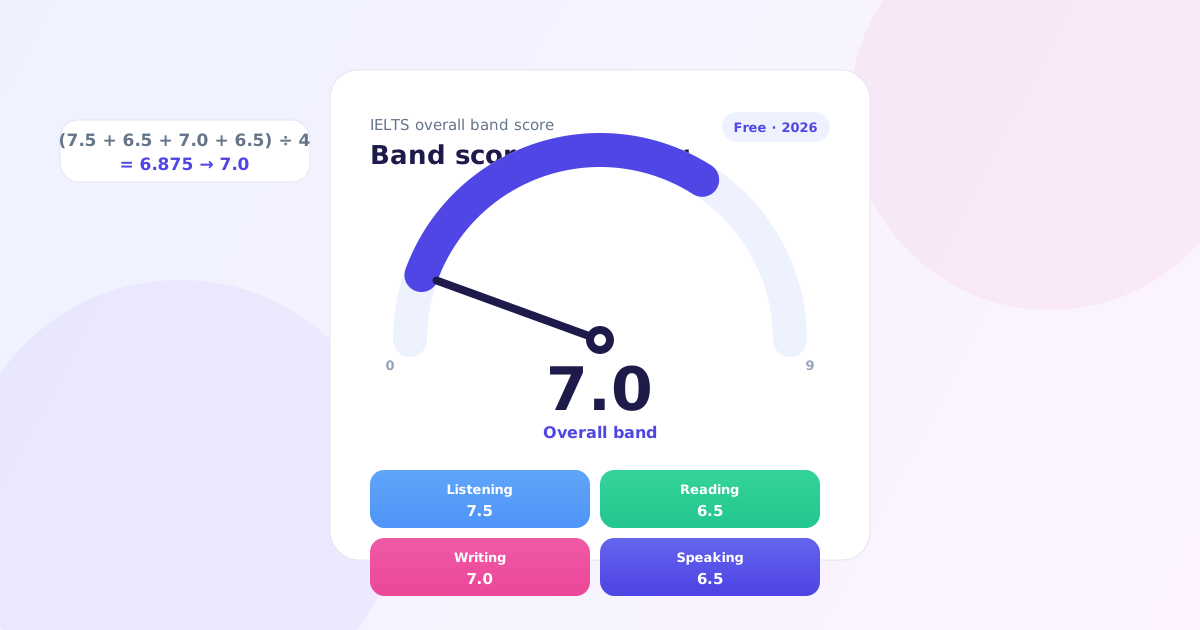
So a student scoring 7.5 (L), 6.5 (R), 7.0 (W), 6.5 (S) has a mean of 6.875, which rounds up to 7.0. The calculator above applies exactly these rules.
Raw scores vs band estimates
Listening and Reading are marked out of 40 questions. The conversion from raw score to band changes slightly with every test, so the calculator uses the standard Cambridge practice approximations. Writing and Speaking are marked by examiners against band descriptors, so you can only estimate them — use a recent mock or a teacher's feedback.
The Listening paper has 40 questions and is identical in both Academic and General Training. Each correct answer is one mark; your raw score is converted to a band using a table that varies slightly from test to test. The ranges below are the widely used Cambridge practice approximations.
| Raw score (out of 40) | Band |
|---|---|
| 39–40 | 9.0 |
| 37–38 | 8.5 |
| 35–36 | 8.0 |
| 32–34 | 7.5 |
| 30–31 | 7.0 |
| 26–29 | 6.5 |
| 23–25 | 6.0 |
| 18–22 | 5.5 |
| 16–17 | 5.0 |
| 13–15 | 4.5 |
| 10–12 | 4.0 |
| 7–9 | 3.5 |
| 5–6 | 3.0 |
| 3–4 | 2.5 |
| 1–2 | 2.0 |
| 0 | 1.0 |
A typical band 7.0 in Listening needs about 30 correct answers. Because the audio is the same every time and the question types repeat, Listening is usually the fastest skill to improve — the 30-day study plan schedules a full section every day.
The Academic Reading paper also has 40 questions across three passages drawn from journals, books and magazines. The conversion below is the standard Academic approximation.
| Raw score (out of 40) | Band |
|---|---|
| 39–40 | 9.0 |
| 37–38 | 8.5 |
| 35–36 | 8.0 |
| 33–34 | 7.5 |
| 30–32 | 7.0 |
| 27–29 | 6.5 |
| 23–26 | 6.0 |
| 19–22 | 5.5 |
| 15–18 | 5.0 |
| 13–14 | 4.5 |
| 10–12 | 4.0 |
| 7–9 | 3.5 |
| 5–6 | 3.0 |
| 3–4 | 2.5 |
| 1–2 | 2.0 |
| 0 | 1.0 |
Band 7.0 in Academic Reading typically needs about 30 correct answers — roughly 10 per passage. For the question-type strategy behind those marks, see our True/False/Not Given guide.
General Training Reading uses everyday texts — notices, ads, timetables, workplace documents — so the passages are easier than Academic. To keep the scores comparable, the conversion is different: you need more correct answers in GT for the same band. This is the most common source of confusion when people compare scores across the two tests.
| Raw score (out of 40) | Band |
|---|---|
| 40 | 9.0 |
| 39 | 8.5 |
| 37–38 | 8.0 |
| 35–36 | 7.5 |
| 32–34 | 7.0 |
| 30–31 | 6.5 |
| 27–29 | 6.0 |
| 23–26 | 5.5 |
| 19–22 | 5.0 |
| 15–18 | 4.5 |
| 12–14 | 4.0 |
| 9–11 | 3.5 |
| 6–8 | 3.0 |
| 4–5 | 2.5 |
| 2–3 | 2.0 |
| 0–1 | 1.0 |
Same raw score, different band
A raw score of 26 gives 6.5 in Academic Reading but only 5.5 in General Training Reading. If you're comparing your practice scores to a friend's, always check which Reading paper each of you took.
Canada doesn't use IELTS bands directly. IRCC converts each General Training skill score to a Canadian Language Benchmark (CLB) level — and only the General Training module is accepted for Express Entry. Each skill converts separately; your overall band is never used.
| CLB level | Listening | Reading | Writing | Speaking |
|---|---|---|---|---|
| CLB 10 | 8.5–9.0 | 8.0–9.0 | 7.5–9.0 | 7.5–9.0 |
| CLB 9 | 8.0 | 7.0 | 7.0 | 7.0 |
| CLB 8 | 7.5 | 6.5 | 6.5 | 6.5 |
| CLB 7 | 6.0–7.0 | 6.0 | 6.0 | 6.0 |
| CLB 6 | 5.5 | 5.0 | 5.5 | 5.5 |
| CLB 5 | 5.0 | 4.0 | 5.0 | 5.0 |
| CLB 4 | 4.5 | 3.5 | 4.0 | 4.0 |
The two numbers every Canada applicant should know: CLB 7 (6.0 in all four skills) is the Federal Skilled Worker minimum, and CLB 9 — the “8777” (L 8.0, R 7.0, W 7.0, S 7.0) — is where the big CRS points sit. Most successful Express Entry profiles target CLB 9 or higher.
Your target band depends entirely on what the score is for. The table below is a practical starting point — always confirm the current requirement with the university, employer or immigration authority before you book.
| Destination | Test | Typical requirement |
|---|---|---|
| Canada PR — Express Entry | General Training | CLB 7 minimum (L 6.0, R 6.0, W 6.0, S 6.0). Competitive applicants target CLB 9 — the “8777” (L 8.0, R 7.0, W 7.0, S 7.0) — for more CRS points. |
| Canada PR — Provincial Nominee | General Training | CLB 4–5 minimum for many streams; Express Entry-linked streams inherit the CLB 7 federal floor. |
| UK — Student visa (degree level) | Academic (IELTS for UKVI) | B2 minimum for the visa; universities usually ask 6.0–7.0 overall with per-skill minimums. |
| UK — Skilled Worker visa | Academic or General Training (IELTS for UKVI) | B1 minimum (≈ 4.0 in each skill) for most roles. Regulated professions (nursing, teaching, law) set their own, usually higher, requirements. |
| Australia — skilled migration | General Training (Academic also accepted) | 6.0 in all bands minimum (“competent”); 7.0 (“proficient”) and 8.0 (“superior”) earn extra points. |
| Australia — university entry | Academic | 6.0–7.0 overall depending on course; teaching, nursing, law and medicine often 7.0+. |
| New Zealand — skilled residence | Academic or General Training | 6.5 overall for the principal applicant. |
| New Zealand — university entry | Academic | 6.0–6.5 overall depending on institution. |
| Typical university entry (worldwide) | Academic | Undergraduate 6.0–6.5; postgraduate 6.5–7.0; usually no skill below 5.5–6.0. |
Requirements change
Immigration rules and university entry standards are updated regularly. Use this table to set a realistic target, then verify against the official source — for example IRCC (Canada), the Home Office (UK), Home Affairs (Australia) or Immigration New Zealand.
IELTS reports each skill on a nine-band scale from 0 (did not attempt) to 9 (expert user), in half-band increments. Your overall band is the average of the four skills, rounded to the nearest whole or half band. The full 0–9 descriptors are explained in our band score guide.
The two Reading papers use different passages — Academic draws on journals and textbooks, General Training on everyday texts like notices, ads and workplace documents. Because the GT passages are easier, the raw-score conversion is different: you need more correct answers in GT to reach the same band. Listening, Writing Task 2 and Speaking are scored the same way in both versions.
Add your four skill bands and divide by four, then round to the nearest half band. A mean ending in .25 rounds up to the next half band (6.25 → 6.5) and a mean ending in .75 rounds up to the next whole band (6.75 → 7.0). The calculator above applies exactly these rules.
As a rough guide: about 30 out of 40 in Listening, about 30 out of 40 in Academic Reading, and about 32–34 out of 40 in General Training Reading. The exact conversion changes with every test, so treat these as practice approximations, not guarantees.
CLB (Canadian Language Benchmark) is the scale IRCC uses for Canadian immigration. IRCC converts each IELTS General Training skill score to a CLB level — CLB 7 equals 6.0 in all four skills, and CLB 9 equals the “8777” (L 8.0, R 7.0, W 7.0, S 7.0). Only the General Training module is accepted for Express Entry.
No. IRCC accepts only IELTS General Training for Express Entry and most economic immigration programs. If you book Academic by mistake, you'll need to retake General Training before applying. Academic is the right choice for university admission instead.
Once you know your current overall band, the fastest way to raise it is a structured plan that targets your weakest skill. The free 30-day IELTS study plan sequences 141 tasks across all five skills — including full mock exams — so you can close a half-band gap in a month. For a deeper look at what each band means, read the full band score guide.
141 pre-planned tasks across all five IELTS skills — your first study session is ready the moment you sign up.
Free 30-day plan · No credit card required